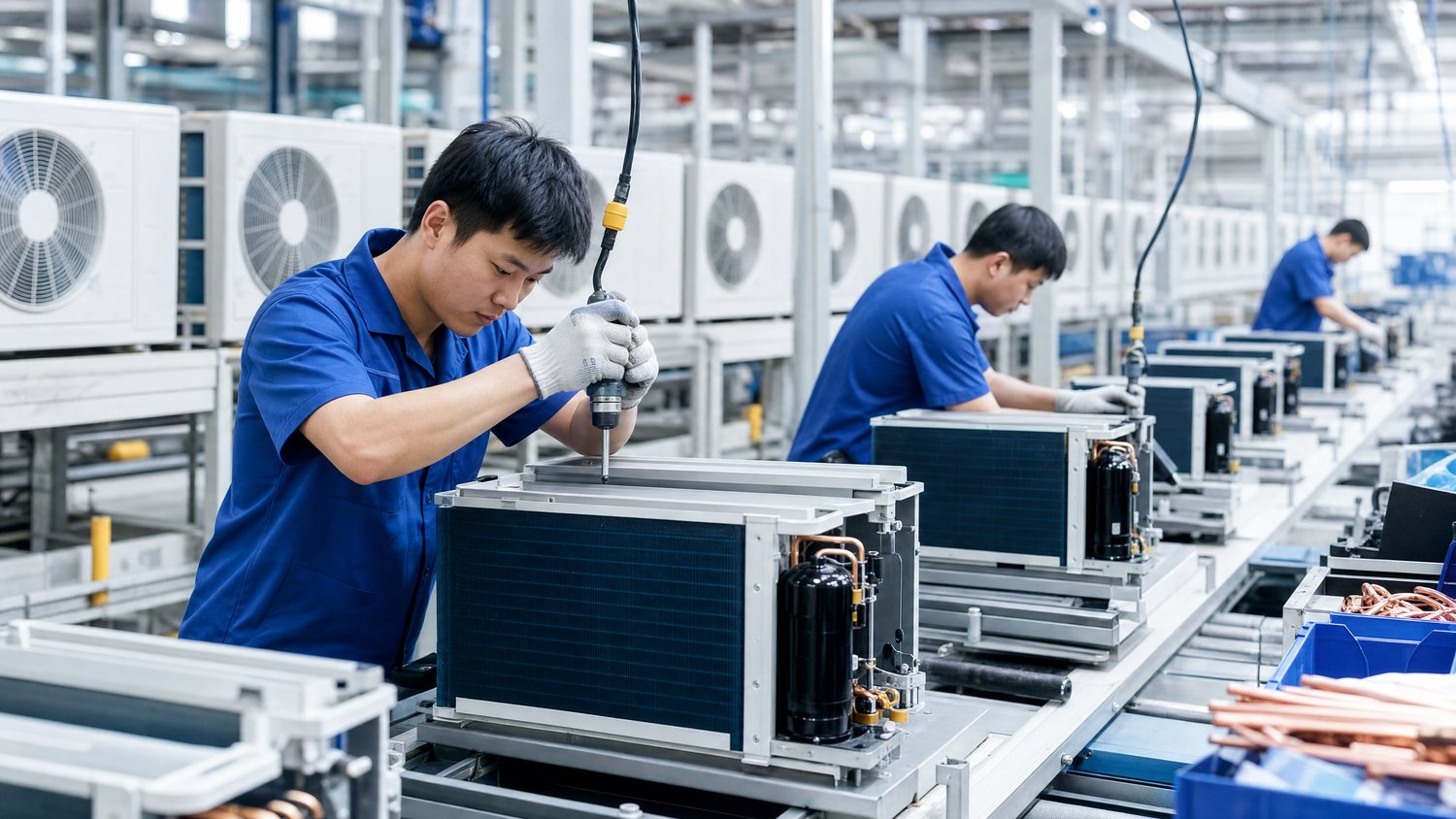
Roughly six out of every ten air conditioners installed anywhere in the world were built in China. That single fact says as much about the country's manufacturing infrastructure as any tire or electronics statistic — worth understanding even for buyers who source nothing in the category, because the same clusters, suppliers and logistics networks touch other product lines.
Two provinces, most of the world's supply
Guangdong alone accounts for more than half of China's air conditioner exports, anchored by brands including Midea, Gree, Haier and TCL, most clustered around Foshan. Anhui province ranks second — one in five air conditioners made in China comes from there — with Zhejiang not far behind at roughly 17% of national export volume. That concentration means a handful of industrial clusters, not a scattered national footprint, define reliability for the whole category.
Why the concentration matters to buyers outside the category
Dense manufacturing clusters exist because of supplier proximity — compressor makers, sheet-metal shops, electronics assemblers and packaging plants sit within a short drive of each other, which is what lets a factory hit a delivery date. The same cluster effect is what makes Chinese tire, auto-parts and appliance manufacturing competitive on lead time, not just price. Understanding how one category clusters helps explain why "made in China" isn't a single supply chain, but several regional ones with very different strengths.
What to watch
As with tires, the AC category is moving toward higher automation and tighter quality documentation as export competition increases. Buyers evaluating any Chinese manufacturing category should expect the same baseline now: named factories, traceable components and inspection reports, not just a quoted unit price.
The lesson generalizes well beyond air conditioners — concentrated, audited manufacturing clusters are what make Chinese sourcing reliable at scale, in whichever category a buyer happens to be importing.